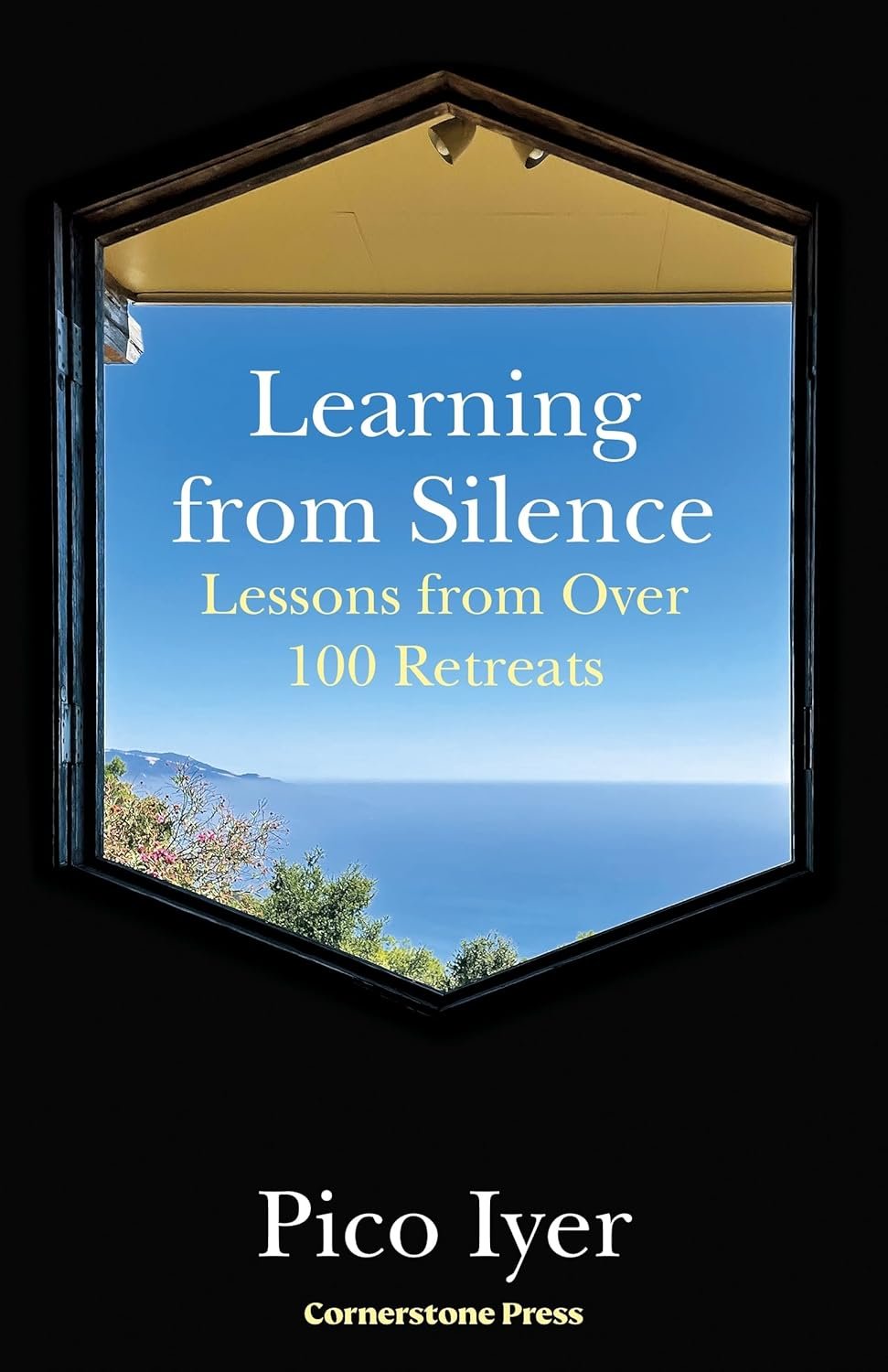
Pico Iyer on Learning from Silence
High on the cliffs of Big Sur sits a hermitage where silence has been practiced for nearly a thousand years. For over thirty of them, Pico Iyer has kept returning to the same ten acres — not to explore, but to stop. The New Camaldoli Hermitage is a Benedictine monastery, founded in 1958 by monks whose order dates to 1012.
Iyer is not religious, yet he has made more than one hundred retreats here. Learning from Silence is his account of what those accumulated hours of quiet have taught him.
“I had come here for a retreat — a secular one in my case — to rediscover a state of mind we forget even exists: inner silence.”
The silence he finds is not escape but reorientation — “a reminder of some deeper truths he misplaced along the way.” While Iyer sits in his borrowed cell, life continues unabated. His house burns down in a California wildfire. His mother suffers a stroke. His daughter is diagnosed with cancer. Silence, he discovers, does not protect you from life — it sharpens your capacity to meet it.
“In my life below, I’m so determined to make the most of every moment; here, simply watching a box of light above the bed, I’m ready at last to let every moment make the most of me.”
That inversion is the monastery’s lesson. Not productivity. Not insight. Not even peace, exactly. Just the quiet dismantling of the self’s constant demands.
“It’s only when I go on retreat that I feel I’m encountering something real — a lens cap has fallen away — and that reminder allows me to see my life in proper proportions.”
The book mirrors the silence it describes. Written in short, epigrammatic fragments drawn from decades of notes, it moves non-linearly, resisting climax or conversion. There is no epiphany here. Only the slow accumulation of hours, and the changes they work beneath the surface.
The monks ask nothing of visitors beyond “a spirit of quiet and recollection.” That simplicity is the point. Silence at New Camaldoli is not performance. It is the uncomfortable work of sitting with what cannot be controlled or explained. Asked if retreat is selfish, Iyer answers plainly: “For me, it’s the only way I can learn to be a little less selfish.”